Professor
J. Fred Weston was a giant in the field of M&A. He arrived at UCLA from
Chicago in 1949 and over his career wrote 32 books and 147 journal articles,
many of which dealt with corporate development. He mentored outstanding
graduate students, including Nobel laureate Bill Sharpe.
Professor
J. Fred Weston was a giant in the field of M&A. He arrived at UCLA from
Chicago in 1949 and over his career wrote 32 books and 147 journal articles,
many of which dealt with corporate development. He mentored outstanding
graduate students, including Nobel laureate Bill Sharpe.
I recall Fred telling the story about
how the word synergy came to be used in corporate deal making.
The year was 1950, and Fred was at lunch in Westwood with executives from a
nascent industry that would later become aerospace. Fred saw a drink menu on
the table that promoted Irish Coffee, The Perfect Synergy. (Irish
Coffee blends coffee and Irish whiskey, topped with whipped cream.)
Not knowing what synergy meant,
Fred looked up the term after he returned to his office and saw synergy =
the interaction of two or more agents so that their combined effect is greater
than the sum of their individual effects. "Now that's what M&A
activities are supposed to do," thought Fred. He started using synergy in
his writings to characterize successful deals, and the term became a
cornerstone of professional thinking.
Enter Apple and Disney. Video
streaming is vital to Disney’s future, highlighted by the announcement of
Disney+ on April 11. Video streaming is escalating in importance to Apple, given
the introduction of a new Apple TV app and the commitment to develop an
original program streaming service known as Apple TV+.
Will these two companies alchemically
blend resources in this area? Is an Irish Coffee in the making?
We used Word2Vec to process the 854
articles that appeared on Dow Jones/Factiva between April 11 and May 18, in
which the word Disney+ appeared. (Word2vec
processes raw text and positions words in a high dimensional vector space where
semantically similar words are placed at nearby points. Factiva is a global
news resource with over 32,000 premium publications.)
Here are some of the words/bigrams
appearing closest to Disney+ (a score nearer 1 indicates a word is closer to
Disney+):
('launch_november', 0.946),
('apple_tv+', 0.801),
('netflix', 0.774),
('india', 0.719),
('amazon_prime', 0.642),
(‘warnermedia’, 0.615
('mandalorian', 0.589)
Note that:
- India is
prominent, given the planned launch of Disney+ on Hotstar, an OTT service
acquired in the 21st Century Fox deal. Disney+ could have a huge
impact on the Indian streaming market.
- The
Mandalorian (set after the Return of the Jedi) is also prominent, given that
this will be a prestige series developed for Disney+. The Mandalarian will parallel
the Game of Thrones in budget (some $10 million per episode) and hopes to rival
its success.
But here’s a key observation to
consider:
- Apple TV+
appears very close to Disney+, closer
than other services such as Netflix or WarnerMedia.
Although some of the “closeness”
between Disney+ and Apple TV+ may result from major announcements from each
company around this period of time, there’s more to this proximity to consider.
Over the next few years, Apple and
Disney will likely be marching side-by-side in the upcoming streaming wars,
especially for family-friendly content. And there’s a wide range of possible synergy deals that might emerge between
these two companies. Here are some options:
- Disney distributes Disney+ on Apple TV’s app
(probability = .9). Disney has stated
consumers will be able to subscribe to Disney+ on Roku and PlayStation. In a
Bloomberg interview, CEO Bob Iger has stated that the Disney+ app will: “in all
likelihood be available through traditional app distributors, Apple being one
of them.” Apple wants its TV app to be your central hub for video content. It’s
already supported by services such as Hulu, Starz, and HBO. In agreeing to
allow subscription to Disney+ via Apple TV, Disney will deem access to
subscriber data as a critical term in the deal. Such data is central to Disney’s
future in content
creation algorithms, merchandise marketing, theme park promotion, and many
other DTC initiatives.
- Disney develops and licenses exclusive content
for Apple TV+ (probability = .6). If price is right, why not consider this
option – assuming Disney+ has established its audience and Apple+ is not viewed
as a direct competitor. Apple wants to build a hardware/video streaming
virtuous cycle, where hardware drives video streaming services and video
streaming, in turn, motivates hardware sales. It’s unlikely that Apple will
want to compete with Netflix (or Disney) as a video streaming behemoth. There’s
no inherent reason why Disney should not join Prince Harry and Oprah as an Apple+
content development partner.
- Apple TV+ bundled into Disney+ (probability =
.5). Under this scenario, Apple’s appetite for content development subsides and
wants to feature Disney+ as distinguishing video streaming content for its
platform. If so, Apple may risk alienating other content providers such as
HBO/WarnerMedia.
- Disney+ is bundled into Apple TV+ (probability
= .3). Less likely, as Disney is bent on making DTC video as a core element of
its future. Adding Disney+ content would give Apple TV+ an incredible streaming
offering. But Apple would have to be willing to pay dearly for this
opportunity.
- Joint venture between Disney and Apple – call
it DisApp+ (probability = .25). A JV can be an exquisite form of corporate
torture. Witness Hulu, where Disney’s partners included thorny competitors
until Disney obtained full operational control after completing deals with
AT&T and Comcast. But a DisApp+ JV with Apple could be different, pooling
Apple’s massive financial resources and huge hardware base with Disney’s
unparalleled family-friendly content library. Each company’s contribution to the JV would be distinctive.
- Apple buys Disney (probability = .1). Apple
and Disney have strong cultural and historical ties including: 1) Steve Jobs
sold Pixar to Disney for $7.4 billion and sat on Disney’s board after becoming
Apple’s largest individual shareholder; 2) Bob Iger has sat on Disney’s board
since 2011. Yet, this would be the largest M&A deal in history, surpassing the
massive Vodafone/Mannesmann deal valued at $202 billion in 1999 (inflation
adjusted value = $304 billion). Disney’s current market capitalization is about
$240 billion, and Apple would have to pay a significant premium to complete an
acquisition. Furthermore, buying Disney would involve acquiring theme parks,
ESPN, consumer products, traditional movie and TV studios, and much more. There
would be a huge regulatory hurdle to overcome.
After the Disney/Pixar deal, one analyst reflected: “If an
alien from Mars observed these two companies from afar, he would ask why are
they separate entities.” Although it’s unlikely that Apple and
Disney will be merged/married into one company, the future for these two
companies will almost certainly involve living together as significant others
in a video streaming relationship.
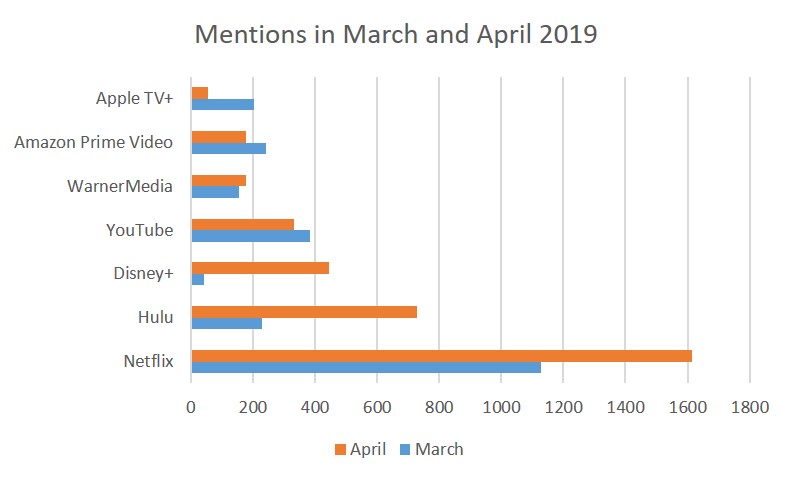
 May was a relatively quiet month for media coverage in the video streaming race. The March/April hoopla surrounding Apple TV+ and Disney+ announcements dissipated, and the pace of press coverage slowed to a trot. Media mentions for Hulu was an exception.